
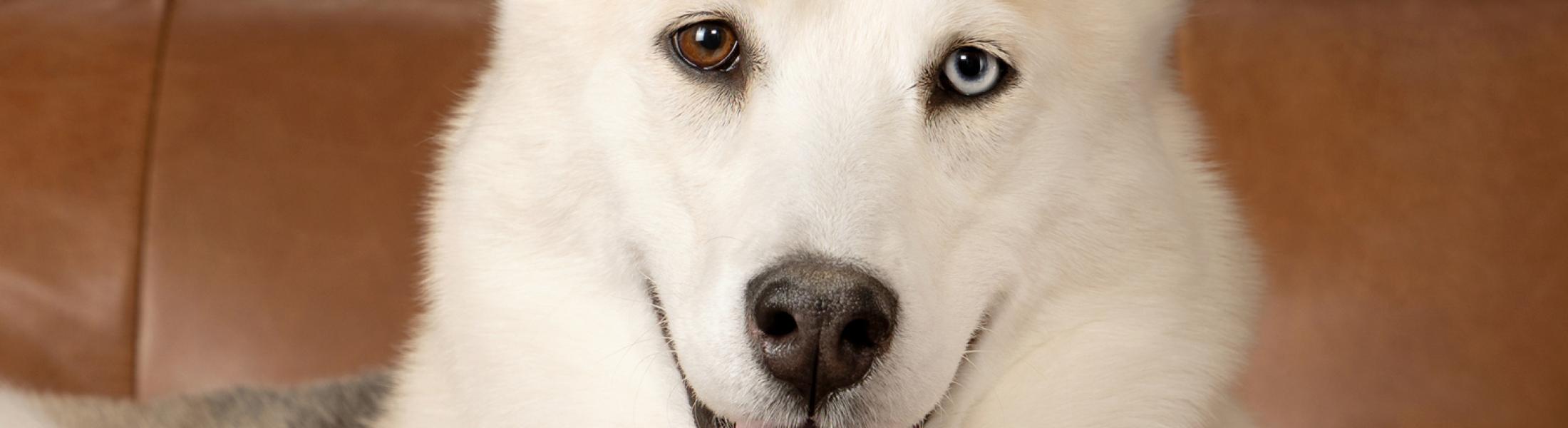
My Husky handles a problem better than most leadership teams.
Her name is Skylar and she has never once left another dog wondering where it stands with her. She is a Husky in every sense of the word: opinionated, communicative, a little dramatic when the situation calls for it, and completely unwilling to let uncertainty linger for very long.
She is not unfriendly. She is clear. There is a difference.
I did not bring Skylar home because I thought she was going to teach me anything about organizations. I got her three months after my twenty-year-old cat died, at a point when almost everything in my life was changing. I had moved from Dallas to Fort Worth, built my house, and was starting a new chapter. A friend in rescue sent me Skylar’s photo one day and that was pretty much it. She moved in about thirty days after I did and immediately acted as though the house had been built for her.
What I did not appreciate at the time was how much I would eventually notice about the way she communicates, sets boundaries, works within a social structure, and responds when something disrupts it.
All things organizations struggle with every day.
Skylar has a best friend named Sophie, a black Lab who has known her long enough to understand one non-negotiable truth about their friendship: there is a Queen, and it is not Sophie.
Sophie knows this. There is no ambiguity, no periodic renegotiation, and no passive-aggressive confusion about who defers to whom. Their relationship has a structure, and because both dogs understand it, neither one spends much time fighting against it.
Mostly, they nap.
That is the part I find interesting. We tend to think clarity about roles, expectations, authority, and boundaries creates tension. In reality, a lot of tension comes from the opposite. People do not know who owns what. Two leaders believe they have the same decision rights. An employee is held accountable for an outcome but has no authority to make the decisions required to produce it. A manager thinks an expectation is obvious while the employee has no idea the expectation exists.
Then everyone starts interpreting.
Sophie does not have to interpret Skylar. The structure is clear, so the relationship can relax.
Where Skylar becomes especially instructive is when another dog comes into her space carrying nervous energy. I mean the frantic, unpredictable kind that changes the feel of the whole environment.
Skylar does not ignore it and hope it resolves itself. She does not spend three weeks quietly becoming more frustrated. She does not ask every other dog to adjust its behavior so nobody has to address the uncomfortable thing happening in front of them.
She growls.
If that is not received, she shows her teeth. If that is still not received, she air snaps. She has never bitten anyone or anything, she is extremely controlled in that manner. Her escalation is proportional and remarkably clear. The other dog gets information, has an opportunity to adjust, and then everybody moves on.
Most organizations handle this very differently.
When one person’s behavior begins disrupting a team, the disruption often gets absorbed into the system instead of addressed directly. People learn how to work around the employee. Managers change their communication. Coworkers avoid certain conversations. Responsibilities get shifted. Exceptions get made. Someone else quietly picks up the work.
Eventually, the workaround becomes normal.
People stop asking why everyone is behaving differently around one person because that is simply how things are done now.
That is when a behavior problem becomes an organizational pattern.
This is where organizations often start blaming the wrong people.
A strong employee gets tired of the situation and leaves, so now the company has a retention problem. A new manager inherits an employee three previous managers struggled with and cannot fix the relationship, so now the company has a leadership problem. People stop raising concerns because nothing ever happens when they do, so now the company has an engagement problem.
Someone finally reacts badly after years of frustration, and suddenly that person’s behavior becomes the issue.
Each one looks like a different people problem when you examine it by itself.
It is not.
The organization has been teaching everyone involved how to operate.
Every conversation that did not happen taught something. Every exception taught something. Every time a leader looked the other way because dealing with the situation felt harder than tolerating it, the organization reinforced the pattern.
Do that long enough and people begin adapting around the behavior instead of expecting the behavior to change.
Then one day leadership looks around and wonders how things got this bad.
They did not get there in one day.
There is another reason I think Skylar is such an interesting comparison for organizations. Huskies are famously vocal. Anyone who has spent much time around one knows they do not suffer silently.
There is history behind that communication.
Huskies were bred to work in teams under difficult conditions. A sled team could not function if every dog decided independently where it wanted to go, what pace it wanted to maintain, or which signals it felt like responding to that day. The dogs had to operate as a unit. They had to pay attention to one another, understand direction, respond to signals, and keep moving together.
In that environment, communication was not a soft skill. Coordination was not something nice to have. The team’s ability to function depended on it.
A company is obviously not a sled team, but the organizational parallel is hard to miss.
A group of individually capable people does not automatically become a capable team. They have to understand the signals. They have to know what is expected, who is leading where, how decisions get made, when something has changed, and what happens when someone stops operating in a way that allows the rest of the team to move.
Most organizations communicate constantly and still leave people guessing.
There are emails that hint at problems without naming them. Meetings that end without decisions. Feedback softened so much that the person receiving it cannot tell there is actually a problem. Leaders who know exactly what needs to change but cannot bring themselves to say it directly.
Then the organization is surprised when people make different interpretations and move in different directions.
That is not a communication volume problem. It is a clarity problem.
The most expensive part comes when an organization finally decides the person is the problem.
The employee leaves or gets replaced. A new manager comes in. Someone restructures the team. Leadership assumes the issue has been handled because the person associated with it is gone.
For a while, things may even feel better.
Then six months later, another version of the same problem appears.
Different name. Different circumstances. Same conversation.
That happens because replacing a person does not necessarily change what the organization taught people to do.
Maybe expectations are still implied instead of stated. Maybe managers still avoid hard conversations until the situation becomes unbearable. Maybe high performers are still allowed to behave differently because leadership is afraid to lose them. Maybe employees still believe raising a concern creates more risk than saying nothing.
A new person walks into that system and starts responding to the same signals everyone before them responded to.
Then leadership asks why they keep having people problems.
Sometimes they do.
But sometimes the person is simply where the pattern became visible.
Skylar is honest about her boundaries and remarkably precise in her communication. Sophie can relax because she knows where she stands. A nervous dog gets information immediately instead of finding out five visits later that everyone has been quietly frustrated the entire time.
Nobody has to guess what the signals mean.
Organizations rarely struggle because absolutely no one knows there is a problem. More often, people know. They have simply learned not to address it directly. Over time, the organization builds processes, relationships, accommodations, and behaviors around whatever it was unwilling to confront.
Eventually, everyone is looking at the people involved instead of the pattern underneath them.
That is how the same problem survives different employees, different managers, different initiatives, and different years.
It’s not the people. It’s the pattern.
Skylar has never left anyone guessing.
Most organizations cannot say the same.
Before you replace the person, check the pattern.
Take the Pattern Check.
Amy Neighbors is the Founder of Knewlynk and a learning and operations transformation expert with 20 years of experience helping organizations build capability and change how work gets done. She holds a Master’s in Education and brings more than 25 years of experience in health and fitness.
She founded Knewlynk on a simple belief: recurring problems are often not people problems, but patterns in how an organization operates. Her work focuses on identifying those patterns and helping organizations build better ways of working that stick.